
April is Pet First Aid Awareness Month, and it’s a great time to go over what to do if your dog is in a medical emergency.
For most injuries and illnesses, you should get to a vet right away. However, in an emergency, like when your dog is bleeding, you may need to provide your pooch with first aid until you can get professional treatment.
Bleeding can be either external or internal. External bleeding is easy to see and usually comes from a skin wound. This wound is obvious, unlike internal bleeding, which is difficult to detect and requires the services of a veterinarian.
A blood loss of as little as two teaspoons per pound of body weight is enough to cause a dog to go into shock. Every dog parent should know how to control or stop bleeding, even if it’s just long enough to get a dog to the vet.
Here’s what you should know about stopping your dog’s bleeding.
How To Stop External Bleeding In Dogs
Listed below, in the order you should perform them, are some techniques to stop or control external bleeding in dogs.
Direct Pressure
Direct, gentle pressure is the method most preferred for stopping external bleeding.
To do this, place a compress of clean cloth or gauze directly over your dog’s wound, applying firm but gentle pressure, and allow it to clot. Do not disturb the clots.
If blood soaks through the compress, do not remove it. Instead, place a fresh compress on top of the old one and continue to apply pressure.
If there are other injuries that need to be addressed, tie the compress in place with bandages or gauze. If there are no compress materials available, your hand or finger will work.
Obviously, you should wash your hands thoroughly after handling any bodily fluids, like blood, and use gloves if they are available.
Elevation
If a wound on the leg or foot is bleeding severely, gently elevate the leg until the wound is above the heart. This allows gravity to reduce blood pressure near the wound, which will slow the bleeding.
Elevation works best for bigger dogs with long legs because there’s a longer distance between the injury and the heart.
Elevation should be used in conjunction with direct pressure and compresses for maximum effectiveness.
Pressure On Artery
If bleeding continues after applying direct pressure and elevation, you’ll need to apply pressure to the artery supplying blood to the injury.
For injuries on the front leg, apply pressure to the brachial artery inside the upper front leg.
For injuries to a back leg, apply pressure to the femoral artery in the groin, and if the injury is to the tail, apply pressure to the caudal artery at the base of the tail.
Continue applying direct pressure as you transport the dog to the veterinarian.
Pressure Above And Below Wound
Applying pressure above the wound will help control arterial blood loss and pressure below the wound will help control bleeding from the veins.
This should be used in conjunction with direct pressure.
Tourniquet
WARNING: A tourniquet is dangerous and should only be used only if the injury is located on the tail or a leg and the dog would otherwise die from blood loss without it.
Wrap a two-inch or wider piece of cloth around the limb twice and knot it.
Tie a short stick or something similar, such as an ink pen, into the knot. Use the stick to tighten the tourniquet until the bleeding stops. Tie the stick to hold it in place and write down the time — this is not a time to rely on your memory.
Every twenty minutes release the tourniquet for fifteen or twenty seconds before tying it down again.
A tourniquet should be used only as a last-ditch effort, as its use will probably result in either a disability or amputation of the affected limb.
Internal Bleeding
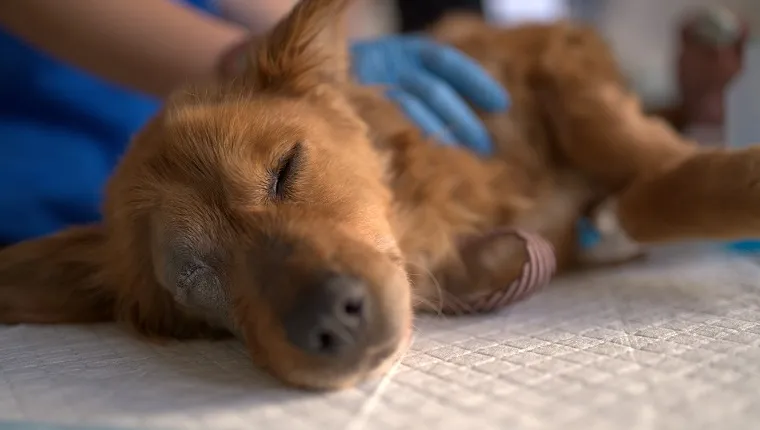
Internal bleeding is not as easy to detect as external bleeding, as it occurs inside the dog’s body and cannot be seen.
You need to check for these visible signs of internal bleeding:
- Gums or eyelids are pale
- Legs, ears, or tail feel cool
- The dog is exceptionally excited or unusually subdued
If your dog shows any of these signs, take them for professional help immediately. Remember, internal bleeding cannot be detected with certainty from the outside.
Do you have any tips for stopping blood loss in dogs? Will you help spread the word for Pet First Aid Awareness Month? Let us know in the comments below!