Teaching your dog the ‘sit’ command
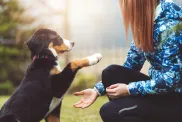
Weigh out your puppydog’s daily diet and take a handful of kibble. Give one piece to the pup to let it know ‘the game’s afoot’, say “Rover, Sit” and then slowly move a second training treat upwards and backwards over the pup’s head, keeping it close to its nose. As your pup lifts its head to follow the food, it will sit down. When the dog sits down, give it the food lure as a reward. Magic? No, just quadrupedial vertebrate structural engineering. Basically, it is impossible for most quadrupeds to look directly upwards without sitting down. We call this ‘the coyote howling at the moon’ posture. Try this on yourself. Stand like a dog (or a football lineman) with arms and legs straight and toes and fingers on the ground and then try to look up at a point on the ceiling directly overhead. This is impossible without: either raising one’s fingers off the ground, or by bending the legs and sitting down.
If your pup raises its forepaws off the ground during this exercise, you are holding the food treat too high. Lower the treat and move it backwards between its eyes only an inch above its head. (To teach the pup to sit on its haunches or stand on its hind legs please see the section on Tricks.) If your dog backs up, perform the exercise in a corner.
Teaching your dog to go from ‘down’ to ‘sit’
With the puppy lying down, say “Rover Sit,” let it sniff another training treat and then move the lure upwards and backwards over the pup’s head. Your pup will push itself up into the sitting position. You may have to waggle the treat or clap your hands over the pup’s head to energize it to sit up. Enticing the larger ‘sack ‘o potato’ breeds to sit up can take no small amount of enthusiasm and mental energy on the part of the trainer. So, get enthusiastic! Once your pup sits, give it the treat for its effort.
Training games: Sit-down-stand sequences
Vary the order of the sit, down, and stand commands at random, or by using the following, easy-to-remember test sequences:
1. sit-down-sit-stand-down-stand
2. sit-stand-sit-down-stand-down
3. down-sit-down-stand-sit-stand
Varying at least three different body positions increases the speed with which the pup learns verbal commands. If we alternated just two body positions, e.g., sit and down – ‘doggy push-ups’, the pup would quickly become bored with endless repetition, and it would anticipate each command rather than listen to the owner’s instructions. For example, the pup quickly learns, if it is sitting, the next command must be “Down.” Varying the order of instructions increases your puppy’s attentiveness and concentration.
For the first sequence only, reward your pup following each change of body position. On the second sequence, reward after every other change, then after three changes and so on until the pup performs an entire sequence of six responses for just one reward. After only a few trials, a single food reward is more than sufficient for your pup to perform several complete sequences in succession. Do no more than five repetitions at any one time, and reserve food rewards for those special responses performed with particular pizzazz and panache.
Repeat the above sequences at least 50 times a day, until you and the pup are picture-perfect. Do NOT do all repetitions at once, or else you will bore your dog silly. Also, performing the exercises in a single training session produces a dog which is only reliable at training times, for example in the kitchen before dinner. To create a dog which is reliable at all times, you must train it at all times in a wide variety of settings. To accomplish this with minimal expenditure of effort and energy, integrate training into your daily routine. Call your dog and perform just one sequence: each time you turn on the stove, open the fridge, make a cup of tea or go to the bathroom, when the clock chimes, when you turn a page of a magazine, book or newspaper, when you turn on the television and during each commercial break and whenever you think of it. Similarly, when walking the dog, perform a single sequence: before putting on and taking off the dog’s leash, each time you go through a door or gate, each time you see another dog or person, each time you pass a lamppost or fire hydrant, before and after crossing the street and, whenever you think of it. You will find it easy to have several hundred mini-training sessions each day without deviating too much from your daily routine. Moreover, when your puppy collides with adolescence, you will find your daily routine runs smoother with a well-trained dog.