Dog training: Walking on-leash

Thursday March 31st, 2011

  • Share on Facebook

Forging ahead is the biggest problem when walking adolescent dogs on-leash. Dogs pull on leash for a variety of reasons. Many adolescent dogs pull on-leash, because they were allowed to pull as puppies. Once the leash is tightened, your dog no longer has to pay attention to you, since it has a taut telegraph wire through which it may sense your every move and even your very intentions, thus freeing its nose, ears and eyes to 'scope the 'hood. Also, it would appear that pulling on leash is intrinsically enjoyable and self-reinforcing for many dogs. It is as if most dogs view a trip to post a letter at Shattuck and Vine as a work-out for the Iditarod. Whatever the reason, leash-pulling is usually unacceptable and often dangerous. Once the leash is tightened, you can no longer control your dog - a principle of elementary physics.

It is considerably easier and smarter to first practice all of these exercises with the young puppy on-leash indoors. Also, to have a simple rule that no one, that is NO ONE, is allowed to walk the pup on-leash outdoors, not even a single step, unless they can walk the puppydog without it pulling. It is utterly unfair to let a puppy develop a leash-pulling habit, knowing full well it will be punished for the same habit as an adolescent. It is so much easier to establish an acceptable status quo from the outset. Just bear in mind, the dog weight-pulling record is in the region of 10,000lbs, i.e., in just a few months time, your average dog will have the power to pull the entire Cowboys' defensive line backwards. From the getgo, NEVER permit leash-pulling to get going.

Using a leash to walk the puppy is necessary as a safety precaution, and leashing the dog is mandatory when leash laws are in effect. However, once a novice owner and an adolescent dog are connected with a leash, the dog will pull. And to stop the dog from pulling, usually (but not always) the owner pulls back, i.e., the owner jerks the leash. Most owners find this unpleasant. And it is not much fun for dogs either. Since we do not want the dog to associate walking and heeling with numerous physical leash corrections, we must first make sure the dog can stand calmly on-leash before further exciting the dog by moving.

Training game: Red light - green light

Firstly, before even considering leash training, make sure that you can get your pup to follow you around the house and garden and that it will happily sit-stay in front of you for a good 30 seconds. Surely you would want to check to see that your puppy feels good about following and staying close before you physically restrain its activity with a leash. After all, leash-pulling does advertise the fact your dog wants to get away from you. So, give your dog a reason to stick around. Lighten up, brighten up and maybe offer the dog an occasional kind word, pat or treat.

Secondly, before going anywhere, let's make sure that your dog knows how to stand around on-leash without pulling. Initially, let's practice indoors because: 1) you may start training well before your pup has completed its shots, 2) there are fewer distractions and 3) it avoids the embarrassment of making a spectacle of oneself on the street.

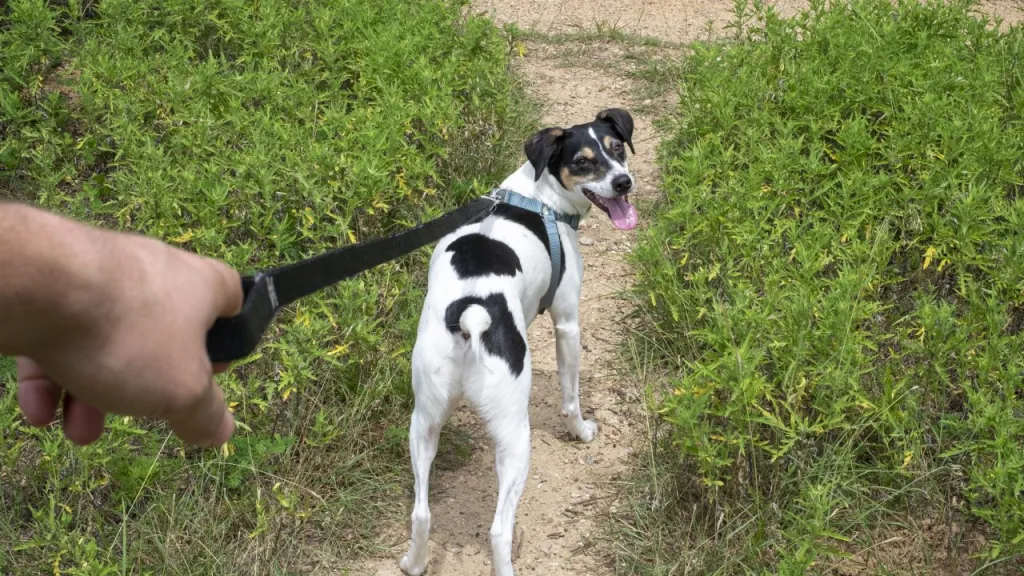
Put your pup on leash. Firmly grasp the end loop with both hands held close to your body. Stand perfectly still, and pay absolute attention to your pup, but ignore all antics at the other end of the leash. Eventually, your pup will sit or lie down. Yes, it will. Just be patient and wait and see. When it does so, immediately say "Good dog," offer a treat, say "Let's Go," take one step forwards and then stand still again. Be prepared; taking a single step will energize your pup, and it will lunge with vengeance. Again, ignore the puppy's antics, and wait until it sits once more. Then, reward your dog, take another step and stand still again. With successive trials, have your dog sit for progressively longer periods before praising it and taking another step. Once it is possible to alternate single steps with standstills without the pup pulling, try taking two steps at a time before standing still. Then try three steps, four steps and so on. As with off-leash heeling, think of it in short sequences. Once the sequences have expanded to six or seven steps, you are now walking your pup on-leash without it pulling, and it will sit automatically by your side whenever you stop. If your puppy ever tightens the leash when you are walking, immediately stand still and wait for it to sit again before moving on.

Basically, this technique is a variation of 'red light - green light,' and as with all effective training methods, you have duped your puppy into believing that it is training you. Perhaps your canine companion muses, "My owners are so easy to train. Just barely tighten the leash, and they stand stay. Sit down, and they move ahead." Your dog's happy, and so are you.

Walking sequences

Practice walking your pup on-leash around the house and garden, interspersed with many stops. Say "Rover, Let's Go" or "Come Along" each time before you walk (again, the precise words do not matter - you choose), and instruct the pup to "Sit" each time you stop. When your puppy is old enough to walk on the sidewalks, first try walking in the hallway with the front door open, then practice leaving and entering the house. Dogs commonly tend to lunge at doorways, and so this is worth a little extra special practice. Leave and return several times in a row, and soon your pup will be picture perfect. Have your puppy sit both before and after going through the door. Then, walk back and forth in front of the house. Walk and standstill in sequences, and keep repeating the sequences over and over. Remember, it is always the hardest the first time you try. If the dog pulls, say "Steady" and stand still. Once the pup sits, go back and repeat the sequence. It will be much easier the next time.

Now, you are ready for several laps round the block. Much like horses, dogs will tend to forge when leaving home but lag when coming back. If the puppy pulls on the way out, say "Steady," about turn, and frog-march the pup back home and start again.

The first trip around the block may take a long time, but the second and third laps are progressively easier, and thereafter, it's a breeze.

Basically, dogs pull because: 1) pulling is enjoyable, 2) the owner lets the dog pull and 3) the owner follows. The same basic principles for teaching dogs to follow off-leash may be used to teach a dog to walk on-leash. Hold the leash with both hands close to the left side of your body, so as to give the puppy just a couple of inches of slack, then start walking and keep walking. Whatever the puppy does to improvise on your intended direction, do the opposite. If the puppy lunges ahead, just do a smooth right-about turn and head off in the opposite direction. If the puppy pulls left, turn right. If the puppy drifts right behind you, turn left. If the puppy drifts right in front of you, speed up to cut-off the pup, and then turn left in front of it. If the puppy slows down to sniff or pee, that's fine - this is usually the reason we are walking the dog - slow down and wait for the pup. Of course, if you want your pup to come along, say "Come Along" and/or "Hustle," and off you go. This method works well when practiced at home with young puppies or in the park with older puppies, adolescent and adult dogs.

Pulling on command

Some owners might consider allowing the dog to pull when convenient. Look, if the dog has got a bee in its bonnet about pulling, if pulling on-leash is such a thrill, why be a killjoy? Why not let the draught doggie pull at acceptable times? Only of course, when given the OK by the owner - "Rover, Pull," "Mush," "Hike" or whatever. Personally, I appreciate Phoenix's tractor beam up the Rose Walk steps and the "Pull" command is a boon when we harness her to our sled in the Sierra: "Phoenie, Pull!" Whoooshhhhh. Yea! Way to go!

Excerpted from How to Teach a New Dog Old Tricks, by Ian Dunbar.

Ian Dunbar is a veterinarian and animal behaviorist, founder of the Association of Pet Dog Trainers, and the author and star of numerous books and videos on dog behavior and training. He lives in Berkeley, California with his wife, trainer Kelly Dunbar, and their three dogs. The Dunbars are contributing editors to DogTime.

Related Content on DogTime.com
  • Dog training: Heeling on-leash

    March 31st, 2011

    Heeling a dog on-leash offers the most controlled manner of walking with a dog. It is most useful when cruising crowded sidewalks or when other dogs and animals are around. For many dogs, unfortunately,...

  • Raising a puppy: Obedience training classes

    March 31st, 2011

    As soon as your puppy is three months old, there is an urgent need to play catch-up in terms of socialization and confidence building with other dogs. At the very latest, before he is eighteen weeks...

  • Finding a puppy: Picking the right breed of dog

    March 31st, 2011

    There are many things to consider when choosing a puppy, including which breed or type, and the optimal age of acquisition. Obviously, you want to choose a dog that is best suited to you and your lifestyle....

Carol

I trained my 2 year old chihuahua/jack russel terrior mix to potty by taking him out on a leash 3 times a day. Now, I would like to untrain him to go in the backyard and take him once daily on a long walk. How do I pull this off. He insists on holding his stuff until I leash him and walk him. He will not let anyone else walk him either.

7 months ago by Carol

Anonymous User

Hi, my puppy doesn't pull (yet anyways) he just lies down and refuses to walk & will not walk down steps .. What should I do about this? He hates his leash! (he also hated his collar at first)

about 2 years ago by Anonymous

Recent conversations on these topics

  • Is it ok to beat your dog when training it?

    i just got a new dog and would like to know if beating when it does something bad is the only effective way to train it? ok if theres one thing I hate, its a dog that doesn't listen. If my dog starts doing something like scratching at a door, what alternatives are there other than yelling at it and hitting it? If I do that, then he'll associate me yelling at him with pain. Then hopefully the next time he does something bad and I yell at him, it will be enough So far, no one has really given any good alternatives. Also, gail, if I give the dog a treat everytime it stops scratching at the door, wouldn't it make him more likely to scratch at the door because he knows he'll get a treat when he stops?

  • Professional Dog Training Service

    You as well as your dog will benefit a lot from the bonding and trust that develops with our <a href="http://dogstrainingservice.weebly.com/"> dog training service</a>. With the help of training provided by our experts, your dog will be able to live a fuller, more enriched life with you and your family.

  • DOG Health

    The dog health is a well studied area in veterinary medicine. Infectious diseases that affect dogs are important not only from a veterinary standpoint, but also because of the risk to public health; an example of this is rabies. Genetic disorders also affect dogs, often due to selective breeding to produce individual dog breeds. Due to the popularity of both commercial and homemade dog foods, nutrition is also a heavily-studied subject. <a href="http://medicalhealthblog.com" rel="dofollow">Medical Health Blog</a>

  • Do Dogs Use Their Body Language With the Intent to Communicate?

    Hi, Dog Lovers! My latest article at PsychologyToday.com is on canine body language. <a href="http://ow.ly/29pa9">Do Dogs Intentionally Use Their Body Language to Communicate?<a> I hope you enjoy it! <a href="http://www.LeeCharlesKelley.com">LCK<a> <i>”Changing the World, One Dog at a Time”</i> <a href="http://www.psychologytoday.com/blog/my-puppy-my-self">My Psychology Today Blog<a> <a href="http://www.facebook.com/LeeCharlesKelley">Join Me on Facebook!<a> <a href="http://twitter.com/_LCK">Follow Me on Twitter!<a>

Welcome to DogTime.com

DOGTIME LOGIN or SIGN UP

AD
AD