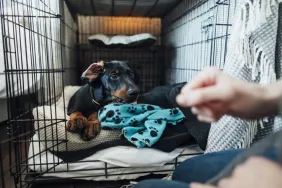
Guarding food bowls and other prized possessions–growling, snarling, and maybe even snapping to keep people away–is common among family dogs. It’s even normal among puppies. But if you let it continue into adolescence and adulthood, it can develop into a complicated and dangerous problem.
Simple and safe training exercises can prevent this problem from ever developing. These exercises teach your puppy that giving up bones and toys means receiving something better in return–praise and treats–and also getting their objects back.
Before you begin, you’ll need to make sure that your puppy has developed a strong chewtoy addiction. Then you can use chewtoys to train her to relinquish objects. (Plus, chewtoyaholics are less likely to seek out inappropriate objects that need to be taken away.)
Teaching trust around toys
Give and take
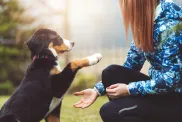
Start with an object that both you and your puppy can hold at the same time, such as a paper towel roll, a plush toy, or a chewtoy (I like a Kong) on a rope. Waggle the object in front of her muzzle enticingly and tell her, “Take it.” Praise your puppy when she takes hold, but don’t let go.
Then stop moving the object, quit tugging, and say, “Puppy, thank you.” With your other hand, waggle a very tasty treat (freeze-dried liver) in front of her nose.
As soon as your puppy lets go of the object, praise her and offer a treat or two (maybe luring the puppy to sit or lie down as you do so). Then instruct your pup to “Take it” again, and repeat the procedure.
When your puppy has quickly relinquished the object on request five times in a row, you may let go of the object each time she takes it.
Now you’re ready to work with smaller objects, such as a tennis balls, or other toys. Once your pup eagerly takes and gives promptly, you can simply drop or toss the object and say, “Thank you.” Your pup will pick up the object and drop it in your hand. Voilà! Your very own faithful retriever pup!
Drop the bone
Before your puppy is ten weeks old, you should repeat this confidence-building exercise many times. Tie a length of stout string to one end of a meaty bone in case your pup isn’t willing to give up this tasty treat. Should the pup growl when you try to take the bone, have an assistant yank on the string to pull the bone away, and quickly cover it with a plastic garbage bucket.
Don’t waste time reprimanding the puppy for growling. Many puppies will initially growl when food is removed. These aren’t bad dogs; they’re normal dogs. However, your puppy must learn that growling doesn’t work, so if she does growl, she must immediately lose her bone or food bowl. When she stops growling, praise her, back up, have her sit and lie down, give her back the object, and then repeat the procedure.
Teaching trust around food
Many old-school training books advise not going near a dog when she’s eating. It may be sound advice to let a trustworthy adult dog eat in peace, but if your pup grows up always eating alone, she won’t want her mealtimes disturbed as an adult. Eventually, someone is bound to bother the dog when she’s eating, and she may growl, snarl, snap, lunge, and possibly even bite.
To make sure your puppy grows up to be totally trustworthy around her food bowl, you can teach her to not only tolerate people during mealtimes, but to look forward to dinnertime guests.
The disappearing food bowl
Hold your pup’s bowl while she eats kibble. Offer her a tasty treat, temporarily remove the bowl as she enjoys it, then give the bowl back to her. Do this several times. Next, try removing the bowl prior to offering a treat. Your pup will soon look forward to your removing the bowl, since it signals that a tasty treat is imminent.
The magic hand
As your puppy is eating dry kibble from her bowl, quickly put your hand in the bowl and offer a tasty treat. Give your puppy time to enjoy the treat, reinvestigate the dry kibble to check for more treats, and to start eating again. Then plunge your hand in the bowl and offer another treat. Repeat the procedure several times.
This exercise impresses puppies to no end–it’s like the magician who pulls a flower from behind someone’s ear–and your pup will soon become accustomed to sudden hand movements around her food bowl.
The walk-by
Sit with your puppy while she’s eating and have family members and friends walk by. Each time someone approaches, spoon a small dollop of canned food on top of the kibble. Your puppy will quickly associate approaching people with juicy canned food being added to her kibble. Later, have family and friends approach and toss a treat into the puppy’s bowl.
The delinquent waiter
Have you ever been kept waiting to order in a restaurant, eating bread and drinking water and wondering, “Where is that waiter? I wish he’d hurry up.” Well, the delinquent waiter game prompts the same reaction in puppies. By the end, most will be begging you to approach their food bowl.
Measure out your puppy’s dinner kibble and then put the pup’s bowl on the floor with only one piece of kibble. Try to capture your puppy’s reaction on camera. She’ll look at the bowl with disbelief. Then she’ll look back and forth between you and her bowl, gobble down the one piece of kibble, and thoroughly sniff the empty bowl.
Casually walk away from the bowl and busy yourself with something else. Maybe inquire as to whether or not your puppy enjoyed her dinner. “Was everything to your liking, Ma’am? Are you ready for your second course?”
Then walk over, pick up her bowl, and place in one more piece of kibble. Ask the pup to sit and then put her bowl on the floor.
This game takes time, but you only need to play it about once a week–soon your puppy will welcome your presence during mealtimes.
By Ian Dunbar, a veterinarian and animal behaviorist, and the author and star of numerous books and videos on dog behavior and training, including Before and After Getting Your Puppy and SIRIUS Puppy Training. He lives in Berkeley, California.