Imagine… you’re searching online for a new puppy and you stumble onto a web site that appears to have just the one you’ve been looking for. According to the site, the pup is vaccinated, in good health, and has his official papers. There are even photos: in one, the puppy is scampering through a field of daisies; in another, he’s curled up by the fireplace in a comfy little bed.
Now imagine that everything you’ve just seen and read is a lie.
The truth is, the vast majority of puppies bought and sold online come from puppy mills, which have recently been fully exposed for the gruesome and inhumane business ventures they are. In the last year, national animal welfare groups, led by the Humane Society of the United States (HSUS), have conducted undercover investigations and spearheaded high-profile busts of these operations, revealing the cruelty and suffering puppy mill dogs are forced to endure. And on March 29, 2008, Oprah Winfrey devoted an entire show to puppy mills, putting the tragedy indelibly on the national radar.
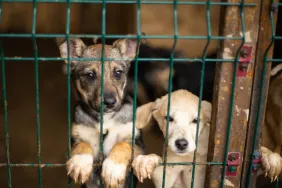
Thanks to the recent exposes, you probably know that puppy mill dogs receive little or no medical care, even when they’re clearly sick or in pain. The animals are kept in tiny wire crates, stacked on top of each other several stories high. There’s barely room to stand, let alone turn around, and urine and feces leak through the mesh flooring to the crates below. The dogs live year round in warehouses with no heating or cooling, even though temperatures can reach below zero in the winter and over a hundred degrees in the summer.
On the Internet, deception is easy
What you may not have heard, however, is that puppies sold online usually come from such places. A new term has even been coined to describe the phenomenon: puppy e-mills. Because the Internet allows for relative anonymity and provides wide exposure to anyone who seeks it, breeders and puppy mill operators can present a picture very different from the one that actually exists.
Mass breeders may say they house the dogs in their own home and post photos to “prove” these claims. In fact, they commonly set up fake web sites to purposely mislead potential buyers. “In general, the Internet makes it very hard to know who and what you’re dealing with,” says Karlin Lillington, who runs cavaliertalk.com, a website for Cavalier King Charles Spaniels enthusiasts. “Remember the famous cartoon, ‘on the Internet, no one knows you’re a dog’? Well, no one knows where that dog really comes from either.”
Even when a site features pictures of adorable pups running through a meadow or curled up on a couch in someone’s living room, the truth can be much more harrowing. Bob Baker, Investigator for the American Society for Prevention of Cruelty to Animals (ASPCA) emphasizes that the only way to be sure your new puppy isn’t a product of cruel and inhumane conditions is to see for yourself where he lives. Even if a breeder says all the right things online, some go to great lengths to ensure that the true nature of their business is not exposed.
“One man in Philadelphia spent $40,000 on a fence to block the view to his operation. He’d rather spend the money there than invest in what it takes to breed and care for animals responsibly,” Baker says. Which raises the question: Does one guy breeding dogs in his backyard qualify as a puppy mill?
Puppy mills defined
People tend to think of puppy mills as places where hundreds of puppies are born, kept in filthy conditions, and then shipped out to the first available buyer. And often, that’s the case. But whether a particular property is home to a few litters, or a few dozen litters, is a moot question. A puppy mill is any situation where the breeder cares more about the profit than the pup.
“Good breeders are most concerned with finding loving, secure homes for their puppies, not how much money they will make,” says Daisy Okas, Spokesperson for the American Kennel Club (AKC). While not all are disreputable, the vast majority of breeders who advertise online do not have the puppies’ or their adult breeding dogs’ best interest in mind.
Okas adds, “Breeders will ask questions about your lifestyle so that they can make a good match between one of their puppies and your family and will be able to provide insight into the pup’s personality so that the most suitable situation will result for both dog and owner.”
Think before you ship
A little investigating can provide more than enough information. Megan Lee, a copywriter from Pleasanton, California, says that when she was looking for a Yorkie pup, she emailed several breeders she found online. Despite claims of being raised in the home with loving care, two sellers offered to ship her their pups at seven weeks of age, a serious red flag.
According to Baker, even shipping a pup a week later, at eight weeks of age, is not a good idea. “Immune systems aren’t developed by then and all kinds of health issues could arise.”
In fact, the idea of shipping dogs of any age is controversial. The experience can be traumatizing for older dogs, and for puppies, it can leave lasting scars. Baker warns that anyone who is willing to ship a puppy on the basis of a valid credit card, without having met the family, does not qualify as a reputable breeder. “The breeder should be screening you harder than you’re screening them,” he says.
Reject puppies sold here
The Internet also happens to make a great dumping ground for dogs. In fact when breeders are left with “reject” puppies that mass brokers or pet stores won’t buy, usually due to health or form problems, the dogs are sold online.
“Online puppies may come in slightly cheaper but buyers frequently end up with huge vet bills or paying in heartache when they end up with a sickly, poorly bred pup,” says Lillington.
While there are laws in place to govern the practice of buying and selling animals, they’re often not a high priority and can be difficult to enforce, especially when breeders are shipping across state lines. In most cities across the U.S., municipal resources are stretched thin, and busting a puppy mill can be very expensive, both in prosecuting the offender and providing care for all the animals.
“Local shelters can barely cope logistically or financially when a few dozen, much less hundreds of breeding dogs and puppies, many of them sickly and all needing vet evaluation, arriving at once,” Lillington says.
The bottom line is that if you’re purchasing online, it’s impossible to know whether you’re dealing with a reputable breeder. “The internet is a great resource if you’re looking for information about dogs, but it’s not a good place to order a dog,” says Baker. He recommends that anyone set on a particular breed first check their local shelter and then a local rescue.” At HSUS, we’re seeing more and more complaints about unhealthy puppies from people purchasing online, whereas it used to be almost all pet stores.”