Raising a puppy: Housetraining

Thursday March 31st, 2011

  • Share on Facebook

Your canine newcomer is just itching to learn household manners. She wants to please, but she has to learn how. Before the young pup can be trusted to have full run of the house, somebody must teach the house rules. There's no point keeping house rules a secret. Somebody has to tell the pup. And that somebody is you. Otherwise, your puppy will let her imagination run wild in her quest for occupational therapy to pass the time of day. Without a firm grounding in canine domestic etiquette, your puppy will be left to improvise in her choice of toys and toilets. The pup will no doubt eliminate in closets and on carpets, and your couches and curtains will be viewed as mere playthings for destruction. Each mistake is a potential disaster, since it heralds many more to come. If your pup is allowed to make "mistakes," bad habits will quickly become the status quo, making it necessary to break bad habits before teaching good ones.

Begin by teaching your puppy good habits from the very first day she comes home. Remember, good habits are just as hard to break as bad habits. Most pressing, your puppy's living quarters need to be designed so that housetraining and chewtoy-training are errorless.

Confinement will help you housetrain

Successful domestic doggy education involves teaching your puppy to train herself through confinement. This prevents mistakes and establishes good habits from the outset. When you are physically or mentally absent, confine your puppy to keep her out of mischief and to help her learn how to act appropriately.
The more you confine your puppy to her Doggy Den and Puppy Playroom during her first few weeks at home, the more freedom she will enjoy as an adult dog for the rest of her life. The more closely you adhere to the following puppy-confinement program, the sooner your puppy will be housetrained and chewtoy trained. And, as an added benefit, your puppy will learn to settle down quickly, quietly, calmly, and happily.

Housetraining your puppy when you're not at home

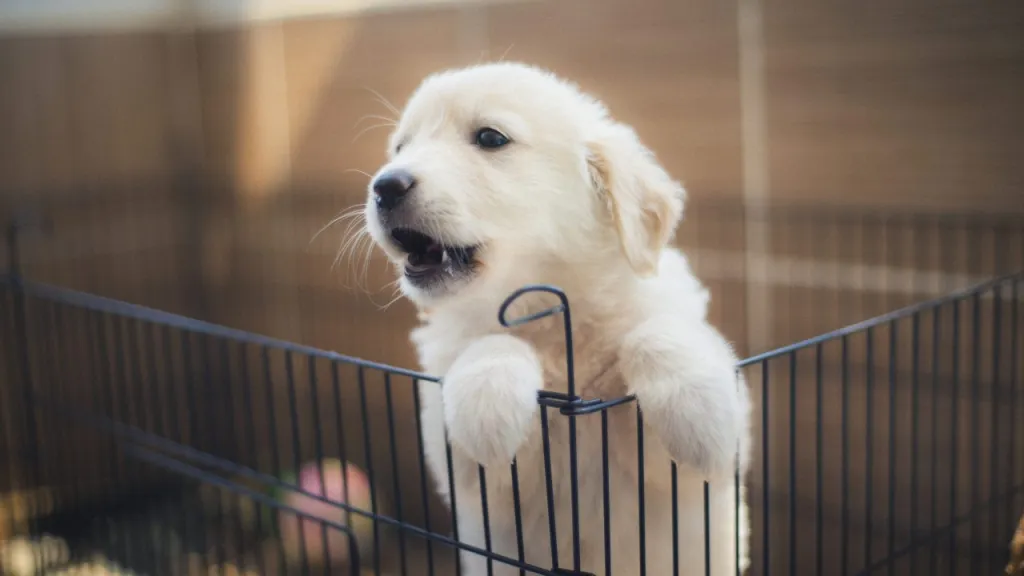
Keep your puppy confined to a fairly small puppy playroom, such as the kitchen, bathroom, or utility room. You can also use an exercise pen to cordon off a small section of a room. This is your puppy's long-term confinement area. It should include:

1. A comfortable bed
2. A bowl of fresh water
3. Plenty of hollow chewtoys (stuffed with dog food)
4. A doggy toilet in the farthest corner from her bed

Obviously, your puppy will feel the need to bark, chew, and eliminate throughout the course of the day, and so she must be left somewhere she can satisfy her needs without causing any damage or annoyance. Your puppy will most probably eliminate as far as possible from her sleeping quarters-in her doggy toilet. By removing all chewable items from the puppy playpen-with the exception of hollow chewtoys stuffed with kibble-you will make chewing chewtoys your puppy's favorite habit, a good habit! Long-term confinement allows your puppy to teach herself to use an appropriate dog toilet, to want to chew appropriate chewtoys, and to settle down quietly.

Housetraining your puppy when you're at home

Enjoy short play and training sessions hourly. If you cannot pay full attention to your puppy's every single second, play with your pup in his Puppy Playpen, where a suitable toilet and toys are available. Or, for periods of no longer than an hour at a time, confine your puppy to his Doggy Den (short-term close confinement area), such as a portable dog crate. Every hour, release your puppy and quickly take him to his doggy toilet. Your puppy's short-term confinement area should include a comfortable bed, and plenty of hollow chewtoys (stuffed with dog food).

It is much easier to watch your pup if he is settled down in a single spot. Either you may move the crate so that your puppy is in the same room as you, or you may want to confine your pup to a different room to start preparing him for times when he will be left at home alone. If you do not like the idea of confining your puppy to a dog crate, you may tie the leash to your belt and have the pup settle down at your feet. Or you may fasten the leash to an eye-hook in the baseboard next to your puppy's bed, basket, or mat. To prevent the chewtoys from rolling out of reach, also tie them to the eye-hook.

Train your puppy to housetrain himself

Housetraining and chewtoy-training will be quick and easy if you adhere to the puppy confinement plan above, which prevents the puppy from making mistakes and prompts the puppy to teach herself household etiquette. If you vary from the program, you will likely experience problems. Unless you enjoy problems, you must reprimand yourself for any mistakes you allow your puppy to make.

Preventing housetraining mistakes

Housesoiling is a spatial problem, involving perfectly normal, natural, and necessary canine behaviors (peeing and pooping) performed in inappropriate places.

Housetraining is quickly and easily accomplished by praising your puppy and offering a food treat when she eliminates in an appropriate toilet area. Once your pup realizes that her eliminatory products are the equivalent of coins in a food vending machine-that feces and urine may be cashed in for tasty treats-your pup will be clamoring to eliminate in the appropriate spot, because soiling the house does not bring equivalent fringe benefits.

Housesoiling is also a temporal problem: either the puppy is in the wrong place at the right time (confined indoors with full bladder and bowels), or the puppy is in the right place at the wrong time (outdoors in the yard or on a walk, but with empty bladder and bowels).

Timing is the essence of successful housetraining. Indeed, efficient and effective housetraining depends upon the owner being able to predict when the puppy needs to eliminate so that she may be directed to an appropriate toilet area and more than adequately rewarded for doing the right thing in the right place at the right time.

Usually, puppies urinate within half a minute of waking up from a nap and usually defecate within a couple of minutes of that. But who has the time to hang around to wait for puppy to wake up and pee and poop? Instead it's a better plan to wake up the puppy yourself, when you are ready and the time is right.

Short-term confinement offers a convenient means to accurately predict when your puppy needs to relieve herself. Confining a pup to a small area strongly inhibits her from urinating or defecating, since she doesn't want to soil her sleeping area. Hence, the puppy is highly likely to want to eliminate immediately after being released from confinement.

If errorless housetraining is so easy, why do so many dog owners experience problems? Here are some common questions and answers that help make errorless housetraining work.

Using an indoor doggy toilet

For the best doggy toilet, equip a litter box or cover a piece of old linoleum with what will be the dog's eventual toilet material. For example, for rural and suburban pups who will eventually be taught to relieve themselves outside on earth or grass, lay down a roll of turf. For urban puppies who will eventually be taught to eliminate at curbside, lay down a couple of thin concrete tiles. Your puppy will soon develop a very strong natural preference for eliminating on similar outdoor surfaces whenever he can.

If you have a backyard dog toilet area, in addition to the indoor playroom toilet, take your pup to his outdoor toilet in the yard whenever you release him from his doggy den. If you live in an apartment and do not have a yard, teach your puppy to use his indoor toilet until he is old enough to venture outdoors at three months of age.

Training you puppy to use an outdoor toilet

For the first few weeks, take your puppy outside on-leash. Hurry to his toilet area and then stand still to allow the puppy to circle (as he would normally do before eliminating). Reward your puppy each time he "goes" in the designated spot. If you have a fenced yard, you may later take your puppy outside off-leash and let him choose where he would like to eliminate. But make sure to reward him differentially according to how close he hits ground zero. Offer one treat for doing it outside quickly, two treats for doing it within, say, five yards of the doggy toilet, three treats for within two yards, and five treats for a bull's eye.

Excerpted from Before You Get Your Puppy, by Ian Dunbar.

Ian Dunbar is a veterinarian and animal behaviorist, founder of the Association of Pet Dog Trainers, and the author and star of numerous books and videos on dog behavior and training. He lives in Berkeley, California with his wife, trainer Kelly Dunbar, and their three dogs. The Dunbars are contributing editors to DogTime.

Related Content on DogTime.com
  • Raising a puppy: Housetraining FAQs

    March 31st, 2011

    Here are some common questions and answers that help make errorless housetraining work. Why confine the pup to his doggy den? Why not his playroom?Short-term close confinement allows you to predict...

  • Raising a puppy: Training your puppy to be home alone

    March 31st, 2011

    All owners find it occasionally necessary to leave their puppydog at home alone. So before leaving your puppy for long periods, you should teach him how to amuse himself appropriately when left alone,...

  • Raising a puppy: Training your puppy what to chew

    March 31st, 2011

    The dog is a social and inquisitive animal. He needs to do something, especially if left at home alone. What would you like your dog to do? Crosswords? Needlepoint? Watch soaps on the telly? You must...

mstowers

We just got a 3 year old Peekapoo and we can't get him to stop peeing in the house? I'm afraid it may already be a habit from his previous owner? What is the best way to train him now? Thanks

2 months ago by mstowers

Anonymous User

my mom said i can get a dog, and i said how do you housetrain it, she said when it pees or poops in the house then i have to rub his/her nose in it, i looked this up online and it said that this is almost like rewarding them as most dog breeds like this kind of thing, please help me!

over 1 year ago by Anonymous

Anonymous User

my 8month dachshund also uses the bathroom outside but still goes in the house as well what can i try next

over 2 years ago by Anonymous

Anonymous User

my dog i a 1yr old lasa, he goes out all the time, but he still uses the house as a out house im getting to the point of wanting to give him up. i love cody but i dont know what to do. please help

over 3 years ago by Anonymous

Recent conversations on these topics

  • Is it ok to beat your dog when training it?

    i just got a new dog and would like to know if beating when it does something bad is the only effective way to train it? ok if theres one thing I hate, its a dog that doesn't listen. If my dog starts doing something like scratching at a door, what alternatives are there other than yelling at it and hitting it? If I do that, then he'll associate me yelling at him with pain. Then hopefully the next time he does something bad and I yell at him, it will be enough So far, no one has really given any good alternatives. Also, gail, if I give the dog a treat everytime it stops scratching at the door, wouldn't it make him more likely to scratch at the door because he knows he'll get a treat when he stops?

  • Professional Dog Training Service

    You as well as your dog will benefit a lot from the bonding and trust that develops with our <a href="http://dogstrainingservice.weebly.com/"> dog training service</a>. With the help of training provided by our experts, your dog will be able to live a fuller, more enriched life with you and your family.

  • DOG Health

    The dog health is a well studied area in veterinary medicine. Infectious diseases that affect dogs are important not only from a veterinary standpoint, but also because of the risk to public health; an example of this is rabies. Genetic disorders also affect dogs, often due to selective breeding to produce individual dog breeds. Due to the popularity of both commercial and homemade dog foods, nutrition is also a heavily-studied subject. <a href="http://medicalhealthblog.com" rel="dofollow">Medical Health Blog</a>

  • Do Dogs Use Their Body Language With the Intent to Communicate?

    Hi, Dog Lovers! My latest article at PsychologyToday.com is on canine body language. <a href="http://ow.ly/29pa9">Do Dogs Intentionally Use Their Body Language to Communicate?<a> I hope you enjoy it! <a href="http://www.LeeCharlesKelley.com">LCK<a> <i>”Changing the World, One Dog at a Time”</i> <a href="http://www.psychologytoday.com/blog/my-puppy-my-self">My Psychology Today Blog<a> <a href="http://www.facebook.com/LeeCharlesKelley">Join Me on Facebook!<a> <a href="http://twitter.com/_LCK">Follow Me on Twitter!<a>

Welcome to DogTime.com

DOGTIME LOGIN or SIGN UP

AD
AD