A spay surgery prevents female dogs from getting pregnant by removing both the ovaries and the uterus. Some people refer to it as getting your dog “fixed.”
It’s not as simple as the neuter surgery the guy dogs get; in fact, it’s major surgery. But your darling girl will only be affected for a few days, maybe a couple weeks. Afterward, she’ll enjoy many health benefits, and neither of you will have to deal with her being in heat. That’ll give you and your pup a lot more freedom.
Some dog parents think they can prevent pregnancy by keeping their pooches in secure yards and staying on the lookout for unwelcome males. Think you can just keep away unwanted suitors? Even experienced breeders get “oops” litters. Dogs will jump gates, bolt through doors, dig under fences, and jump out of cars to mate.
When dogs with raging hormones get together at the wrong time, you could have undesirable consequences — maybe that reminds you of some humans you know.
There are many myths surrounding both spaying and neutering, and you should take time to learn the facts before you make a decision about the procedure. Here are a few things you should know about spaying your female dog.
Benefits Of Spaying Your Female Dog

Of course, the primary benefit of spaying your female dog is that she won’t give birth to any puppies and contribute to pet overpopulation. Hundreds of thousands of dogs are euthanized in shelters every year because of overpopulation, so spaying is extremely important.
But that’s not the only benefit of spaying. Here are a few more reasons to spay your dog:
- Spaying reduces risk of certain illnesses, such as pyometra (a common, life-threatening infection of the uterus) or mammary gland cancer.
- Spaying saves you from dealing with males who are wildly attracted to your dog in heat.
- You don’t have to choose between a dog in sanitary pads or mess all over your house. Leaving her in the backyard so she won’t make a mess inside is not a good choice unless you’re purposely trying to mate her to the most persistent male in the area.
- Spaying eliminates the rather unattractive (read: totally offensive) odor often associated with a dog in heat. Your nose may not be as sensitive as your dog’s, but even you will be able to smell this.
Remember, unspayed female dogs go into heat about once every eight months, and it lasts for as long as three weeks each time. Also, they don’t go into menopause. They regularly go into heat for their entire lives unless they’re spayed.
When It’s Time To Spay Your Dog
The best way to find out an appropriate time to spay your female dog is by asking your veterinarian. Your vet can consider your dog’s individual needs and make a recommendation.
Most female dogs can be spayed any time after eight weeks of age, and preferably before their first heat for the best health benefits.
The first heat cycle occurs somewhere around six to seven months of age, depending on the breed. Many vets will wait until a dog is close to that age to spay because they are more likely to tolerate the necessary anesthesia.
However, a fully-grown, larger dog can be more difficult to spay than a smaller dog, which is why your vet should be involved in the decision of when to perform the spay procedure.
Your dog’s size should not factor into whether or not you get her spayed at all. Vets are quite capable of spaying any size of dog. Size only affects the optimum time to spay and may make things easier for the vet.
If you hold off on getting the procedure done, or if you adopted an older, unaltered female dog, you have to account for her heat cycle before surgery. Vets will typically not recommend spaying while your dog is in heat. More blood flows to the affected area during this time, and that can complicate the surgery.
Your vet might want to wait two to three months after your dog’s heat cycle to spay.
Preparing Your Dog For Surgery

Your veterinarian will usually offer pre-surgical blood work to make sure your dog is healthy enough for surgery and doesn’t have any health conditions that would affect the choice of anesthesia. Typically, young and healthy dogs don’t have any issues, but it’s a good idea to have a baseline reference for future blood tests.
Follow the directions your clinic gives, but generally speaking, your dog should not eat for at least eight hours before the surgery because the anesthesia may cause nausea. Drinking water beforehand is usually fine, but check with your vet.
What To Expect Post-Surgery
Spaying is a common but fairly major surgery. Your veterinarian will give you instructions for post-surgery care, and your dog will likely recover completely within a couple of weeks.
Here are some things you can expect after your dog is spayed:
- Some clinics allow you to pick her up and take her home the day of the surgery, and some want her to remain overnight.
- Pain medication can be given for those dogs who need it, but most don’t.
- The dog might have some nausea and turn away from food for the first day or two. No need to be an overbearing parent and force your dog to eat; she’ll be fine even if she misses a few meals.
- Restrict her activity for the following week since a lot of movement or exercise can cause swelling or allow fluid to accumulate under the incision.
- Stitches will need to be removed after about seven to ten days, depending on the type of stitch material used. Your vet will give you details about how to check that the incision is healing and when to come back in for this final detail. Some modern stitches fall out on their own after a certain amount of time.
- Some dogs cough after surgery because the anesthesia tube, which is put down the throat, can cause irritation. Don’t worry unless it last more than a couple of days; after that, call your vet.
- Your dog may want to play as she starts to feel better, but try to restrict physical activity until she has recovered. Your vet can advise you on when it is okay to let your dog exercise again.
- If she keeps licking the stitches, pop an Elizabethan collar — “cone of shame” — around her neck.
Things To Watch For After Surgery
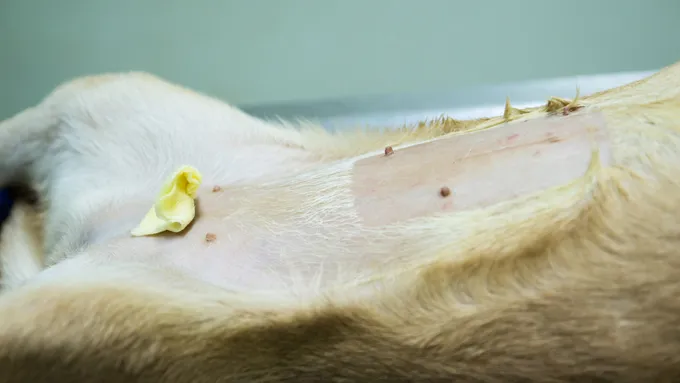
Check with your vet if there’s a discharge from the incision, or if your dog seems to be in excessive pain. It’s rare for a dog to need pain medication, but it’s not unheard of.
If the dog keeps licking the stitches, use an Elizabethan collar to prevent this. Some dogs have trouble walking while wearing these, and they bonk into doorways and tables. Nonetheless, have the dog wear it even during sleep, because licking can prevent the incision from healing properly.
Call your vet if you see any unusual symptoms or changes that concern you. You may notice immediately after surgery that your dog isn’t her usual self. She may feel lethargic or have low energy. Give her some time to recover before you start to worry.
The spaying procedure can make your dog calmer overall, but dogs – for the most part – tend to bounce back to their usual personalities after recovery. Some dogs are more affected than others, though, so talk to your vet if you’re concerned.
Has your dog been spayed? What advice do you have for someone considering the procedure for their dog? Let us know in the comments below!