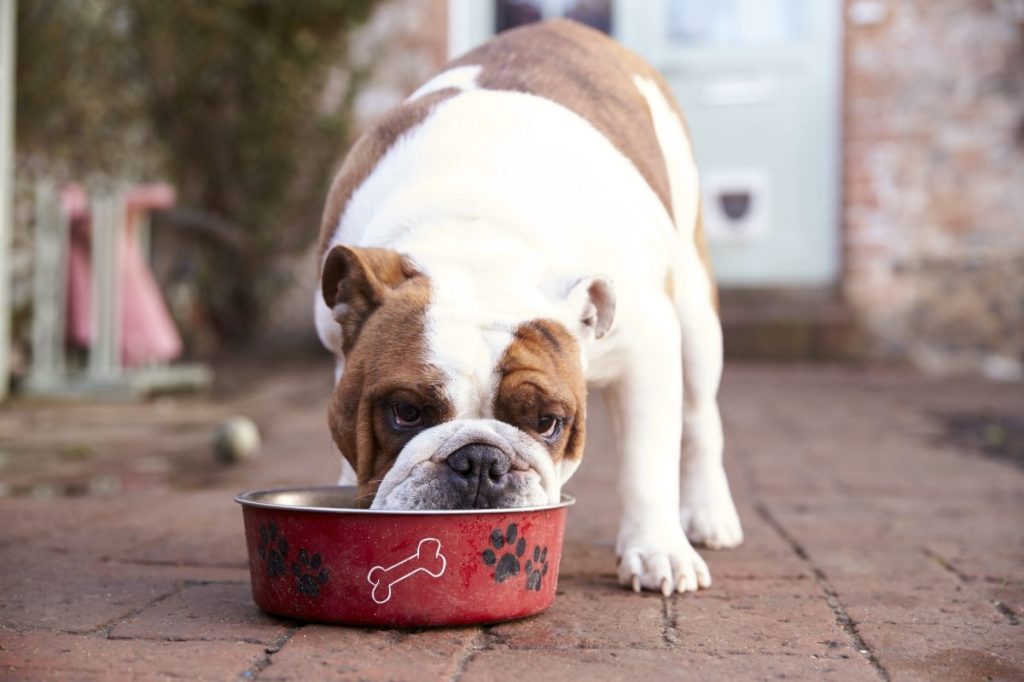
Your dog is looking at you with those big brown eyes. Your heart melts, and you reach for a treat. Their tail wags, and you feel content. But are you really doing your dog any favors if they become overweight? No! That’s why we’re going to help you reverse course with some dog diet tips.
The problem with using food to make your dog feel good
According to Ernest Ward, DVM, instant gratification comes in healthier forms.
“Instead of giving your dog a treat or refilling his bowl with extra food, why not give him a pat on the head, a hug, or make time for a quick toss of his favorite chew toy?” he says. “Most of us confuse affection with confection.”
Dr. Ward says, “I treat a lot of overweight dogs and cats in my practice, and the number of overweight pets continues to rise. Years ago, this problem really didn’t exist.”
More than 50 percent of dogs in the U.S. are overweight.
“It’s a serious problem,” Dr. Ward says of the pet obesity epidemic, “because there is a direct correlation between obesity and disease.”
“We have learned that being overweight is not healthy for humans. Why should it be any different for pets? It’s not,” Dr. Ward says. “Carrying around extra fat brings on heart disease, arthritis, high blood pressure, and type II diabetes. It also shortens the lifespan of dogs and cats. I want my pets around as long as possible.”
A good diet can improve your dog’s health
On a positive note, these ailments are preventable and some are reversible with a good diet and a fair amount of exercise. Dr. Ward suggests starting your puppy on a healthy diet.
“In our culture, we have to change our way of thinking,” he explains. “We often reward ourselves, our children, and our pets with food. Why not take a walk with your dog? We have become couch potatoes and our dogs have become lap potatoes.”
Implementing healthy eating habits is much easier with a puppy than with a full-grown dog.
“Puppies don’t know they are not supposed to be eating treats,” says Dr. Ward. “Overeating is something that we all learn — dogs and people, which means that we can learn to eat healthy and to exercise. Talk to your veterinarian to see how much food your dog should get. Obviously, large dogs eat more food and more meals per day than small dogs.”
“You should also read the labels on the cans and bags of dog food. Look at the calorie count. Avoid dog biscuits. If you really want to give your dog a treat, feed him crunchy baby carrots, broccoli, peas, and asparagus — just a small handful of raw vegetables. They are filled with vitamins and are naturally sweet.”
It’s easy to start a puppy out on this regimen. It’s more challenging changing the behaviors of pet parents who have overfed their dogs over the course of several months or a few years. In those cases, your dog expects to be rewarded with extra food and treats.
Putting your dog on a diet
When Dr. Ward treats an overweight dog, he first checks for certain diseases like Cushing’s disease, which causes fat around the belly. (Cushing’s disease is an endocrine disorder caused by high levels of a hormone called cortisol.)
If he rules out disease, Dr. Ward will put his clients’ dogs on a diet. “Putting a dog on a diet is a process of retraining people and their pets,” he explains. “I have never found a dog that would prefer food over play. Dogs, like most of us, prefer attention. So, that’s an easy start. Instead of filling your dog’s dish, go for a walk, pet him, or give him a good brushing.”
Dr. Ward also suggests setting exact or near-exact times for meals. “Put down the food bowl in the morning and in the early evening,” he says. “If the dog doesn’t eat all of it, pick it up. Don’t let your dog graze.”
What you can feed your dog while on a diet
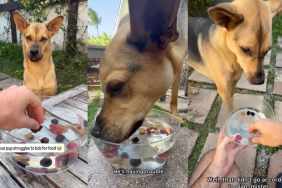
You can feed dogs plain ice cubes or ice cubes with tiny bits of fruit in them. It’s a good option on hot days. He also suggests refilling the water bowl often with fresh water. In addition, Dr. Ward gives his dogs vitamin supplements, like lecithin and omega-3 fatty acids (i.e. fish oil). Lecithin and omega-3 support brain health.
The importance of exercise
Remember that exercise is an important part of combating weight gain.
“Many people think that by letting their dog have access to their backyard, that the dog will get plenty of exercise,” says Dr. Ward. “That is so not true. When you first let your dog outside, he will run around. As soon as you leave for work, he will probably retreat to the dog house and sleep for the rest of the day.”
Dr. Ward adds: “Dogs are social animals, and they need human interaction. Take a walk with them — a brisk, long walk. You and your dog will both benefit by feeling fit and by bonding.”